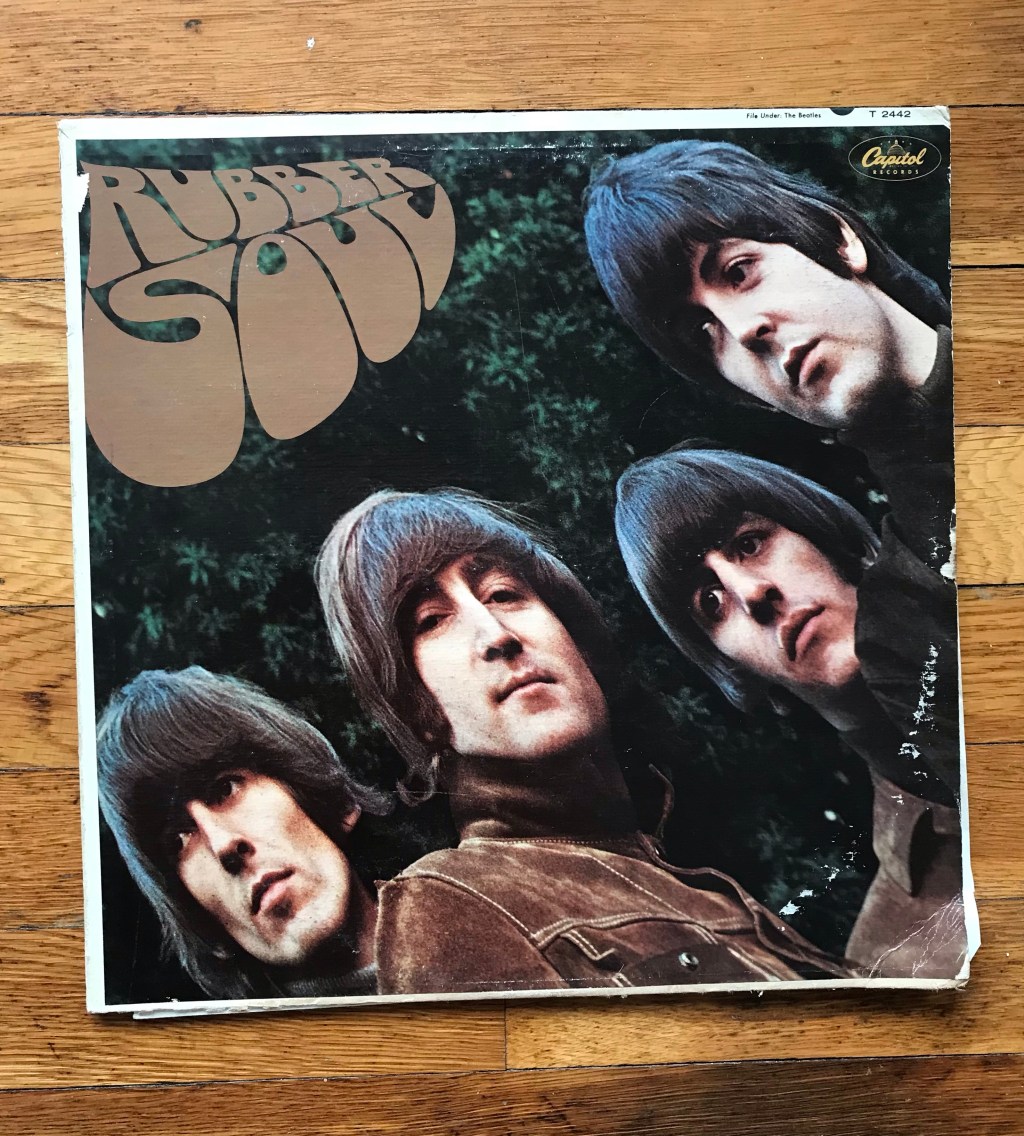
The Beatles’ album Rubber Soul guides us through the peaks and trials of a relationship with love – not with a person but with love itself.
What is love? How do you define it? How do you know when you feel it? Why do we convince ourselves love is there, or could be, or was? How do we justify “love” when feelings are unreciprocated? Why do we confuse this with passion?
My guess for the latter questions is because often we learn about love from other people who don’t understand it either.
Some people do have healthy, secure relationships with love. Their desire for it is matched by the ability to remain calm in the face of fiery passion and to assure their partner (or potential partner) that love is renewable, not finite or conditional.
But songs about secure love are categorically boring. Who wants to hear about how great and secure someone else’s relationship is? It seems that healthy relationships are private while the chaotic emotions of unhealthy relationships are relatable, therefore publicly discussable.
Before I overstep and draw wider conclusions, let’s get back to Rubber Soul.
From obsession to passive aggression to downright threats, the Fab Four take the listener on a journey through Mismatched Love on the back of Poorly Learned Love. Vulnerability is at stake but never mutually exchanged. The parties involved reciprocate intensity but never love. Expressions of intense attraction, disdain, and conviction that this person is the one who checks all the boxes so carefully curated by an eager heart bounce around the record on catchy melodies.
Interestingly, the album pressed in 1966 has a different track list than the “remastered” version available on streaming sites. Instead of opening with the bubbly and perhaps naively passionate “I’ve Just Seen a Face,” the remastered version begins with the impossibly cool, knight-in-shining-armor energy of “Drive My Car.” Different tracks are peppered throughout the original twelve. Why? There’s probably a simple answer: more tracks on an album means it will be listened to more, algorithmically; the band recorded much more than was ever pressed. But I’d like to look at a more complicated, applicable possibility: altering memories changes narratives.
With Rubber Soul we can see how art mimics the mysteries of neurology by redesigning memories to fit new narratives. Whether we are protecting ourselves from pain or deliberately manipulating a story to serve our own ego (and the two are not mutually exclusive), how and what you remember about an event determines the way you live moving forward. Importantly, your narrative determines how you treat other people.
I’d claim that love is the ultimate connective tissue between two people. Varying degrees of love define how you act and what you say to another person. Love is also an emotion that feeds on everything around it, chaos included. Some of us are more prone to chaotic energy than others, and it makes defining, finding, and keeping love a great challenge.
Rubber Soul (the original) puts music to this struggle between what you feel, what you want, what you experience, and how you change in a relationship with love. Here’s the track list with a brief interpretation of each song from the original 1966 record:
Rubber Soul, 1966, Capitol Records
“I’ve Just Seen a Face” – or the blissful ah-ha moment of a chance encounter – melancholy bursts into passion when “a face” appears and dissolves the gloom of loneliness. This girl will be different!
“Norwegian Wood” – or when expectations are not met because the object of your affection objects – a girl offers things that aren’t there and laughs at the irony while John bides his time – but his time never comes.
“You Won’t See Me” – or frustration with emotional unavailability – Paul recognizes what is going on and it hurts. Seeing the girl in person becomes the problem and the solution as he clings to the hope that seeing her will provide clarity or at the very least a clue. Most tragic line: “I wouldn’t mind if I knew what I was missing.”
“Think for Yourself” – or ‘you do you’ – unleashing all the vitriolic insights on an ex’s shortcomings and flaws. As if we, the heartbroken and healing, still (or ever did) hold enough of their respect to be heard.
“The Word” – or emotional rebirth of the easily persuaded – opening with a bluesy riff, love becomes the ultimate goal, the prize. A snide jab at the many who glorify love as the panacea for all of life’s ails.
“Michelle” – or love through limited control – a soft, emotional repackaging of “I’ve Just Seen a Face,” but this time the person is even more out of reach because of a language barrier. If Paul can say “I love you” in exactly the right way, she’ll understand that she feels the same way and the world will be as it should. As if love is something understood and not felt.
“It’s Only Love” – or how to let a relationship bore you to death – a sedated approach to love. It’s not the chaotic passion John and Paul are used to. Love should be easy, but not so easy that you’re numb. “It’s only love after all” – or minimizing the thing you want most!
“Girl” – or the oral tradition of longing – the girl on a pedestal indeed looked down on your from it. A tender moment of understanding a person’s past conditioning makes the listener feel almost sorry for the girl who “makes you feel like a fool.”
“I’m Looking Through You” – or breaking the spell – we no longer need to pretend that what we needed was nurtured by a person who disappeared or perhaps was never there. Yet Paul continues to ask questions that will never be answered. Resolution stings in its clarity: “love has a nasty habit of disappearing over night.”
“In My Life” – or what enlightened love will be like – the first song on the record about “me,” a reflection on life and love. I won’t lose myself this time, I’ve evolved, sing John and Paul. “Memories lose their meaning” – what we have is new and different from anything experienced before. The past is in the past, we are the present and future.
“Wait” – or please have patience – if you need to leave, I’ll understand. But please stay if you’re strong. A challenge dangled from the rafters of love.
“Run For Your Life” – or violence with a catchy tune – jealousy consumes the relationship and total possession takes effect. This song is markedly different from the others, in tone and musicality. The lyrics speak for themselves: “I’d rather see you dead little girl, than to be with another man…// Let this be a sermon, I mean everything I said/ Baby I’m determined and I’d rather see you dead…// You better keep your head little girl or you won’t know where I am.” No more Mr. Longing for Love.
Love is as diverse as the people who feel it, and it can be darker than the people who believe they don’t. May this album be the precautionary tale for what a relationship with love shouldn’t be, won’t be, and never was.
PSA: get a record player, buy some records, and enjoy the beauty of music merged with time.
Keep in touch.
 species of value
Leave a comment